Baseball Between U12 European Champions and MLB All-Stars
Jackie Robinson Ballpark smells like The Sandlot. In MLB, the All-Stars take the stage. Germany's youngest national team has just won the European title. What needs to happen now.

Julian Pollersbeck is on the mound. Jackie Robinson Ballpark, Hamburg, Stealers vs. Mainz Athletics. First pitch. He lets it rip. The ball lands in front of home plate. Spiked. His first pitch in Regensburg had been clean, so this time he took more risk. Too much. There are worse mistakes.
What comes next makes the evening. He heads into the broadcast booth, a cubbyhole the announcer built himself out of chipboard. The air conditioning gives out. Thanks to a foul ball on the livestream, Pollersbeck spots that his trunk is standing open in the parking lot. He sprints out, shuts it, grabs a burger. Recommendation: the burgers at Jackie Robinson Ballpark are legendary. This is no big-city drama. This is baseball in Hamburg.
The Sandlot, Hamburg Edition
The ballpark bears Jackie Robinson's name. Paintings of him hang on the walls. Everything has its own touch. Tight, homemade, honest. Pollersbeck says it reminds him of The Sandlot, the field the kids built for themselves because there was no other. That's not a drawback. It's character.
Hamburg is not Regensburg. The Legionäre's facility is professional, modern, bigger. Hamburg doesn't have that. Hamburg has paintings and a homemade booth. And after the game, the Stealers players' kids take over the field. One of them is Luna, a player's daughter, ten years old, who wants to be a soccer goalkeeper. She talks Pollersbeck into a few minutes of goalkeeper training. His prediction: in ten years, Germany will have a new national team goalkeeper. The Stealers win 6-3. Ninth inning, bases loaded, two outs, and then they get it done.
Halftime in the Big Leagues
Eighty-nine games. Then a break. MLB reaches the halfway mark. All-Star Break, mid-July. No other major pro league has a break like this in the middle of the season. The NBA plays its All-Star Game in February, when the regular season has yet to feel any pressure. The NFL doesn't need a break, because there are only seventeen games. Baseball has 162. And then this one week when nobody has to take the field.
The Home Run Derby was held in Philadelphia. New format: no longer timed, but counted in swings. Twenty in the first round, fifteen after that. Whoever makes the most of the last remaining swing gets to keep going. The result: you can enjoy the homers again, the camera keeps up, the players can take their time. Jordan Walker wins. Bryce Harper and Kyle Schwarber compete in front of their home crowd, which gives the Derby the kind of local energy these formats need.
One small blemish: T-Mobile sponsors magenta balls for the final round so they stand out from the regular ones. The hitters visibly struggle with them. The pitcher throwing to Walker in the final quietly kept handing over regular balls. What else are they supposed to do? Walker wins anyway.
The best story of the first half, though, is the story of a single player. The leading roles here belong to the Chicago White Sox. An injured player travels to every road game, sits on the bench with a magic wand and a witch's hat, casts spells on his own teammates and hexes the opponents, and he read out the All-Star selections, normally the manager's job. The fans are coming back. The ballpark is filling up. That's how team chemistry happens.
The most balanced division in the league: the National League Central. Milwaukee Brewers, Chicago Cubs, St. Louis Cardinals, Pittsburgh Pirates, Cincinnati Reds. Four of five teams with winning records, all bunched together, good pitching and good hitting across the board. Chase Burns a breakout star for the Reds, Paul Skenes still electric in Pittsburgh. A division where something tips every week.
And a structural problem that follows the baseball bubble every year: All-Star selection runs through fan voting, not performance. Players with smaller fan bases get in less often. Dodgers and Yankees players have structurally better chances than players from Kansas City or Minnesota, even when those deliver just as well or better. Calls for giving performance more weight are getting louder.
German Youth Success
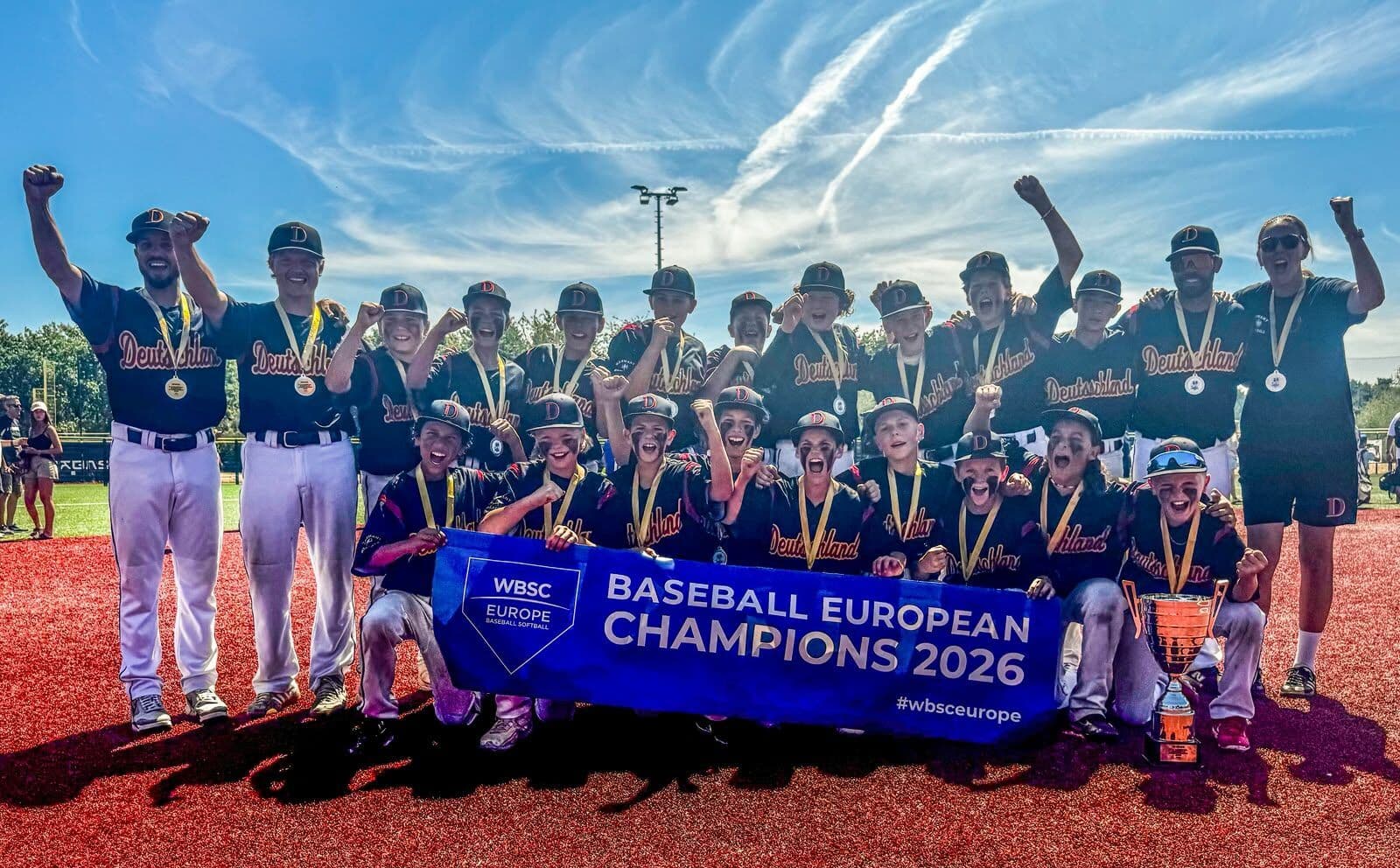
Speaking of strong performances. Germany's U12 national team beat defending champion Czech Republic 6-4 in the final of the European Championship in France and are European champions. The U15 qualified for the World Cup in Mexico by winning last year's European title. A few days ago the U18 played in the European Championship final, lost narrowly to host Italy, and qualified for the World Cup as runners-up. Georg Bull, founder of the Deutsche Baseball Akademie, and his team are behind many of these developments. This is real progress. This is momentum that shows up in results, not just in intentions. Internationally, German baseball is seen as a strongly rising force, more so, incidentally, than at home.
"The earlier you play with better players, the faster you rise to their level."
The Toughest Question in German Baseball
And yet: anyone confronted with this foundation inevitably asks one question. What happens to these twelve-year-olds when they're seventeen? Eighteen? Twenty? Pollersbeck knows the answer from soccer. Not as theory, but as lived experience.
The level you train against every day determines the level you reach. Germany's basketball players didn't become world champions by accident. Year after year they played in stronger leagues, went abroad early, and didn't just watch NBA draft rounds, they were part of them. Franz and Moritz Wagner were taken in the first round. That is the result of a system that started twenty years ago.
Baseball is further behind. That's not criticism. It's a starting point. The jump from youth to adult baseball is the critical point. Anyone who beats Europe's best at twelve or fifteen needs an environment afterwards that keeps developing that level. More international competition at youth level. Better financial support for travel and tournaments. And better pathways to the Major Leagues through colleges and the minor leagues, open to more players than today.
The World Baseball Classic as an Opportunity
Pollersbeck names one concrete lever: qualifying for the World Baseball Classic. "If you qualify for the World Baseball Classic, you get a completely different kind of attention. And maybe a different kind of support, too." That's not a sporting idea but a political one. Whoever plays in the WBC becomes visible. Whoever becomes visible gets funding. Whoever gets funding can build structures that benefit the next generation. The Olympics, now with baseball again, can help as well. The men's European Championship, to be played in Regensburg and Munich next year, is one building block.
Basketball shows how this cycle works once it gets going. Next NBA season will likely see more German players on the court than ever before.
German baseball doesn't have this cycle yet. But it has the foundation for it: successful youth development, a growing pro league, a podcast that talks about these issues, and barely twelve-year-old European champions who are throwing and catching on a backyard field somewhere in Germany right now.
At Jackie Robinson Ballpark in Hamburg, paintings hang on the walls. The announcer built his booth himself. After the game, kids play on the field. These are not small things. This is the ground from which sports grow into something bigger.
Read on
El Alemán
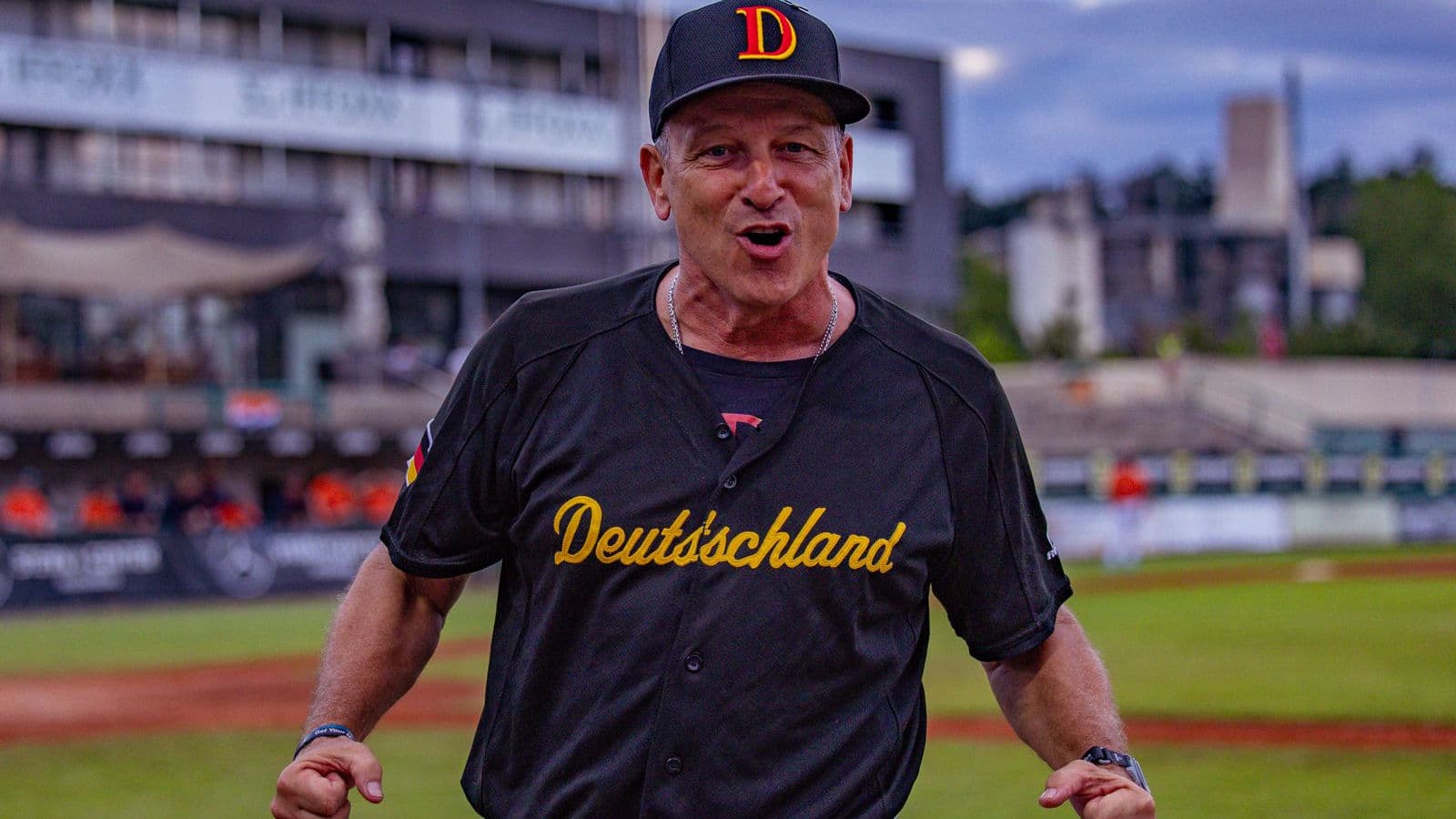
From Mannheim's U.S. military communities to the ballfields of the Dominican Republic, Bull built a coaching philosophy around energy, intelligence, and the stubborn work of developing German players for a global game.

The Tenth Inning: Three Awards for Baseball Culture
In Solingen, Innings presented its Baseball Culture Awards "The Tenth Inning" for the first time. The honorees are Iris Drobny, Brehan Murphy and the Deutsche Baseball Akademie.
Meeting at the point of Intersection
Solingen is the City of Blades. From November 6 to 8 it becomes the meeting point of European baseball. Base on Balls on a letter from America, a financial tightrope walk and two men who could no longer talk their way out of it.