Meeting at the point of Intersection
Solingen is the City of Blades. From November 6 to 8 it becomes the meeting point of European baseball. Base on Balls on a letter from America, a financial tightrope walk and two men who could no longer talk their way out of it.
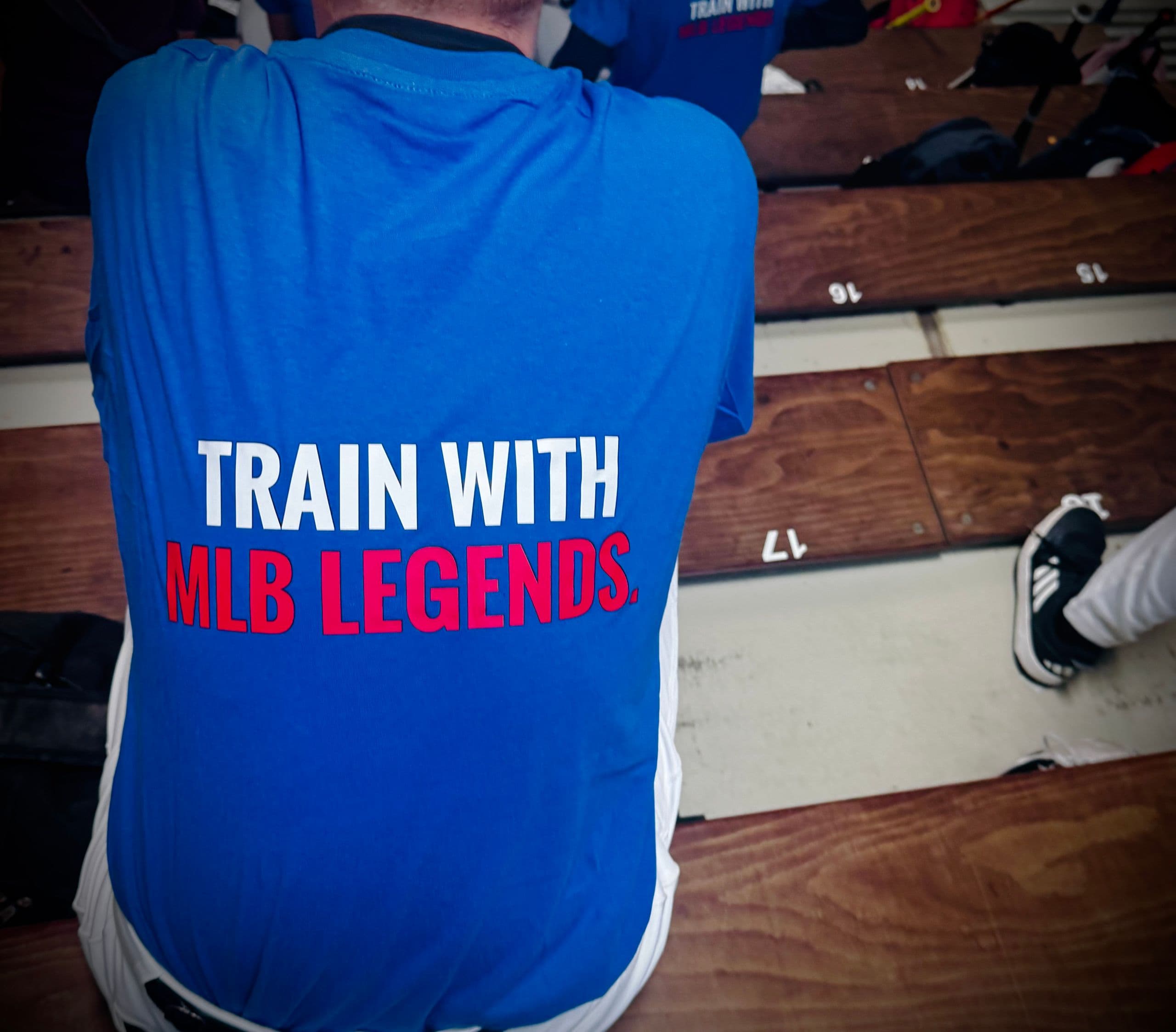
Only a few steps separate Baseballpark Weyersberg from the Klingenhalle. On one side, a field where the Solingen Alligators lose the first game of the 2nd Baseball Bundesliga North finals to the Braunschweig 89ers this Saturday, 0:9. On the other, a hall measuring 57 by 33 meters, where just under four weeks later former major leaguers will show kids how to throw a ball properly.
Two pictures that don't quite fit together. And yet they belong to the same story. Fabian Valkieser, president of the Alligators, and André Hughes, pitcher and club veteran, tell it in conversation with Niko Backspin and Julian Pollersbeck in the new episode of Base on Balls.
The club was founded in 1991 and won the German championship in 2006 and 2014. After the 2021 season it left the Bundesliga, and after the pandemic it came close to folding. Since 2023 Solingen has played in the second division. Next Saturday, October 17, the road back to the top runs through Braunschweig, first pitch 11 a.m. The Alligators trail 0:1 in the best-of-three series. "The guys have to win two on Saturday," says Valkieser.
The Letter
In the nineties, a US select team called Team America toured Germany, the Netherlands and Italy. College players, housed with host families. One of the coaches was Duke Dickerson. Fabian Valkieser was a teenager back then and trained with the Americans, wide-eyed. Dickerson never quite lost sight of Solingen. For decades he kept in loose touch with people at the club.
A little over two years ago, an email landed in Valkieser's inbox. Dickerson wrote that he was retired now and had time for the Alligators. "He got on a plane straight away, came over here and infected us a bit with his American pragmatism," says Valkieser.
The pragmatism turned into an idea called the European Baseball Winter Meeting. Duke Dickerson sees "diamonds in the mountain" in Germany and Europe, André Hughes recalls. They just have to be dug out.
When Dickerson first brought it up, Valkieser only thought: "Who's supposed to do this? How is anyone supposed to do this?" Then came the budget math from the US. They would need at least 500 participants. Shortly after, Dickerson revised the number to 1,000. "We said: okay, now that's a whole different ballgame," says Hughes.
The Call List
Then things moved fast. Dickerson picked up the phone, and one big name after another said yes. Jim Leyritz, catcher on the Yankees team that beat the Atlanta Braves in the 1996 World Series. The same Series in which Spike Lee sat behind home plate in a red cap. To Valkieser, men like Leyritz are "idols from my youth." Add Andrelton Simmons, four-time Gold Glove winner. Hensley Meulens, the first player from Curaçao in the major leagues and later a three-time World Series champion as a coach with the San Francisco Giants. The connections run in many directions. Meulens, Hughes says, is the godfather of Dickerson's son, who carries Hensley as his middle name. Also on board is Ryan Sienko, current catching coach of the Detroit Tigers.
"Then you don't say: call him back and cancel, this is too much for us," Hughes remembers. "You take it on, and then you have to grow into the job." How to organize something like this, they had no idea. "Of course we'd never done anything like it."
Then there is Ron Polk, according to the organizers the winningest coach in the history of the Southeastern Conference and author of "The Baseball Playbook." Valkieser calls it the "baseball coach's bible." Polk is flying across the Atlantic just for this.
Four Venues, One Plan
The format is called Universities. Each session combines theory and practice, from pitching and catching to hitting and umpiring. A vocational college hosts the classroom part; the practical work takes place in the Klingenhalle, in a second hall for infield and outfield, and in the batting cage at the ballpark. Every unit is led by a former MLB pro, with a German co-instructor at his side. Kids aged 8 to 14 and teenagers from 15 can take part. For coaches there is a Coaches University with 15 learning units, recognized by the German Baseball and Softball Federation (DBV) for renewing B and C licenses.
At the time of recording, 436 tickets have been sold. On the day of the conversation, the organizers log their best day yet with 36 sales. Registration closes on October 16, according to the organizers.
Handmade
"It's like a start-up," says Valkieser. "Everything is a bit topsy-turvy, and things keep occurring to you that you forgot." For the hall, the Alligators had indoor mounds and turf produced, mounds worthy of a former pro. "Not something that fell off the back of a discount-store truck." In the end they have to bolt the mounds together themselves, says Hughes.
The cage at the ballpark has just been rebuilt. The reason is not a happy one. In May 2025, an arson attack destroyed the Alligators' batting cage. "It's not like we said, there's a great event coming, let's fix everything up nicely," says Hughes. "We had to." The city responded well, he says, even if it took a while.
And the money? "Financially it's a wild ride and a tightrope walk," says Valkieser. The 500 tickets mark break-even, "and even then we're squinting a bit." They had expected more support from outside sponsors.
The Kassel of European Baseball
Dickerson drew a map. He ran strings from every team to a single point, from the easternmost club in the Czech Republic to the westernmost in France. The center, Hughes says, lies roughly in Solingen. "We're more or less the Kassel of European baseball," he says, a nod to the German city famous for sitting right in the middle of the country.
As of today, participants from eight European nations have registered, among them France, the Czech Republic, Belgium, the Netherlands, Switzerland and Austria. Solingen is not meant to stay the host forever. Next year the meeting could take place in Amsterdam or Rome, says Hughes. "We're building the blueprint," adds Valkieser, for whoever is ready to go second or third.
Behind it lies a thought that is not a given in German baseball. When Hughes pitched the project, the first question was: why should we support the Solingen guys? "I didn't always think about supporting the opponent either," he admits. "But in the end we're such a small community. Just under 30,000 active players, that's just not a lot."
The Green Heart
André Hughes, 41, first hit a ball as a grade-schooler at a summer fair in Hochdahl. The local club had set up a batting cage, and anyone could give it a try. "I hit the ball once and fell head over heels," he says. In 2002 he moved to Solingen because Hochdahl no longer had a team for his age group. He won the German championship in 2006 and 2014. For many years he was part of the national team squad. "Picked up a participation certificate everywhere," he says with a grin.
The game gave him more than titles. It led him to an apprenticeship, and at vocational school he met his wife. His son was born in 2014. At four, the boy told him: Dad, that's enough now, now you stay home. Hughes took a break from 2018 until last year. Today he's back on the field.
Fabian Valkieser, close to 50, has been a member of the Alligators since he was 14. The group that took the field in 1991 is still among his closest friends. When the club was on the brink after the pandemic, those people stepped in. "I'm taking over the club now," Valkieser said at the time, "because I don't want to take away any kid's chance to have this experience." He calls the club's DNA "the green heart."
Phantasialand
Julian Pollersbeck, a professional soccer goalkeeper by trade, has played a few games himself for the Hamburg Stealers' second team. In soccer, he says, everyone on the bench who isn't playing is annoyed. In the dugout, by contrast, everyone pushes the guy who is stepping up to bat. "Soccer is a bit more business," Hughes replies.
Valkieser thinks about the rest of the experience, everything around the game. In the US, people go to the ballpark to meet friends, eat hot dogs and, "if worst comes to worst, take a T-shirt from the T-shirt cannon to the face." Germany needs to become more family-friendly: the kids on a secure playground, Mom and Dad watching. "Right now, even in the top Bundesliga, we take the field, play our nine innings, everybody claps, performance all tip-top. But the feeling of stumbling out of Phantasialand, you definitely don't get that." Phantasialand being Germany's best-known theme park, a short drive from Solingen.
Shining Eyes
When is the event a success? Hughes answers without hesitation, and it is not a ticket number. "When the kids are in the hall with shining eyes and go home afterwards with a smile." Then they can carry the experience onward, into their clubs, to their coaches. Valkieser sees it the same way, with one addition: "Happy kids first, then break-even."
A point of intersection is, at first, just a dot on a map. It only becomes a place once something actually crosses there.