Baseball Culture: The Invisible Game Within the Game
Baseball is a game of ritual, memory, migration and belonging. An essay on why its culture continues long after the final out.

Without culture, baseball lasts nine innings. With it, the game never really ends. On ritual, memory, migration—and what a sport without a game clock tells us about the age of acceleration.
Picture the third inning at Dodger Stadium on a warm Tuesday evening in September.
The pitcher turns slowly on the mound. He touches the brim of his cap—once, twice, three times—then wipes his hand against his pants. He breathes in through his nose and looks toward the catcher. The stadium, moments ago as loud as a freight train, begins to quiet.
For an instant, everything is suspended between windup and pitch.
This is where baseball stops being merely a game. It becomes a gesture. A ritual. A piece of shared knowledge passed between player and crowd.
It becomes culture.
To understand that is to understand baseball.
Culture Is Not What Surrounds the Game
The word culture has been worn thin by modern sports language. Every club claims to have one. Every franchise promotes one. Every press release insists that a new coach, signing, or facility will strengthen it.
But what do we actually mean when we say a team has a strong culture? A slogan on the clubhouse wall? A team dinner after a road game? A manager who knows how to deliver a speech?
In baseball, culture runs deeper. It is not decoration but infrastructure. It shapes what a player becomes, how he responds to failure, and what he passes on to the next person in the locker beside him.
Baseball culture accumulates slowly. It is built over decades and, in some places, generations. It lives in the signals exchanged between coaches and players, in the way a veteran teaches a rookie how to carry himself through a slump, and in the quiet agreement that nobody mentions a no-hitter while it is still in progress.
Some of these customs are practical. Others are superstitious. Many sit somewhere in between. Together, they create the invisible game within the game: the codes that cannot always be found in a rulebook but still determine how baseball is understood.
America and the Civil Religion of Sport
To understand why culture carries so much weight in American sports, it helps to recognize that sport in the United States has never functioned purely as entertainment. It creates identity. It produces national stories. At times, it resembles a form of civil religion.
Few institutions have been used as persistently as baseball to explain America to itself. The game contains stories of migration and mobility, segregation and integration, labor and ownership, nostalgia and reinvention. These are not themes imposed on baseball from the outside. They happened within its stadiums, clubhouses, offices, and stands.
Jackie Robinson did not enter history as a metaphor. On April 15, 1947, he took the field for the Brooklyn Dodgers and broke Major League Baseball’s modern color barrier. He played baseball, and the meaning of who was permitted to represent the game began to change. That history belongs to the sport itself, not to a symbolic interpretation added later.
American football is faster, more forceful, and built for television’s weekly spectacle. Basketball has developed extraordinary cultural power through music, fashion, language, and its global player culture. Baseball has simply had longer to accumulate its myths and contradictions—to become entangled with the country that turned it into a national pastime.
Its history is never only comforting. Baseball carries exclusion alongside belonging, exploitation alongside opportunity, and nostalgia alongside change. That tension is part of its cultural weight.
A Game Without a Game Clock
What separates baseball culturally from most other major sports is also what many non-fans find difficult: its relationship with time.
Major League Baseball has used a pitch timer since 2023, but baseball still has no game clock. The timer regulates the space between actions; it does not determine when the contest ends. A game is not over because the clock reaches zero. It ends only when baseball has completed its internal logic of outs and innings—with more innings added if the score remains tied.
That distinction matters.
In a culture dominated by push notifications, short-form video, and real-time feeds, baseball offers a different model of attention. It asks people to remain present without promising constant spectacle. It rewards patience, observation, memory, and context.
To love baseball is to become comfortable thinking in longer arcs. A season is 162 games. A great hitter still fails in most of his at-bats. A prospect can spend years moving through the farm system before reaching the majors, if he reaches them at all. One pitch can decide a game, but its meaning comes from everything that preceded it.
That is not merely a sporting rhythm. It is a way of looking at the world.
Perhaps this is why baseball fans so often develop an attachment to statistics, history, and ritual. The numbers are rarely experienced as isolated data points. They function as narrative.
No qualified MLB hitter has batted .400 since Ted Williams finished the 1941 season at .406. That single number still carries an entire summer inside it: every at-bat, every adjustment, every final-day decision, and every player who has approached the mark since.
In baseball, statistics do not replace stories. They preserve them.
One Language, Many Dialects
Baseball may still be described as an American game, but it has long since become a global language. Like any language spoken across borders, it has developed different accents, customs, and emotional registers.
In Japan, baseball is yakyū. The game is shaped by preparation, repetition, collective responsibility, and a deep respect for craft. On the field, discipline carries enormous weight. In the stands, however, Japanese baseball can be loud, choreographed, and intensely communal. Nippon Professional Baseball attracts millions of spectators every season, while school baseball occupies a place in national memory that extends far beyond youth sport.
Shohei Ohtani did not emerge from nowhere. He came through a baseball culture that takes refinement and preparation seriously—then became exceptional precisely because he challenged one of the professional game’s most settled assumptions: that an elite player eventually had to choose between hitting and pitching.
The Dominican Republic speaks another baseball dialect. There, the game can be community practice, professional ambition, and economic wager at the same time. Young players and their families often invest years in a path that offers extraordinary possibility but very little certainty.
MLB academies in the Dominican Republic are not simply training facilities. For signed prospects, some only 16 years old, they can become a combination of workplace, school, residence, and gateway into professional baseball. The opportunity is real, but so is the pressure. The dream of the majors is not abstract; it can shape an entire family’s sense of the future.
Year after year, the Dominican Republic provides MLB’s largest group of players born outside the United States—93 on 2026 Opening Day rosters and inactive lists. That influence is visible not only in player numbers, but in the energy, language, style, and joy brought into the league.
Cuba’s relationship with baseball follows a different political and institutional history, but the game is no less entwined with national identity, neighborhood life, and personal ambition. To place Cuba and the Dominican Republic inside one generic “Caribbean pipeline” would miss the point. Baseball may connect them, but it does not erase their differences.
Across many Caribbean and Latin American baseball cultures, emotion is expressed openly: through music, bat flips, dugout dancing, and visible celebration. For generations, MLB’s unwritten rules often framed that expressiveness as disrespectful.
That conflict was never only about etiquette. It was also about authority: who was allowed to define the proper way to play, celebrate, and belong.
A game can have universal rules without producing a universal culture.
The Clubhouse as Its Own Small Country
Much of baseball’s most important cultural work happens away from public view.
The clubhouse is a semi-private world with its own hierarchy, language, humor, routines, and tensions. It is where veterans sit beside rookies, where trust is built or broken, and where lessons are passed on that no coaching manual can fully contain.
It is also where baseball’s international character becomes everyday life. Players from the United States, the Dominican Republic, Venezuela, Cuba, Japan, South Korea, Mexico, and elsewhere spend more time with one another than they do with many members of their own families. Languages, music, food, faith, humor, and ideas about leadership meet in the same room across a six-month season.
That does not automatically make every clubhouse culture healthy. Culture can create belonging, but it can also enforce conformity. It can protect players or isolate them. It can make room for difference or ask everyone to submit to the habits of the most powerful group.
A “strong culture” is therefore not simply one in which everybody gets along. It is one that can hold together under pressure without erasing the people inside it.
Baseball appears highly individual because its decisive encounters are isolated: pitcher against hitter, fielder against ball, runner against throw. But nobody carries a team through a 162-game season alone. The sport depends on shared knowledge, trust, and the ability to absorb failure without allowing it to spread through the room.
That is culture in its most practical form.
The Game That Continues After the Final Out
Baseball without culture is like a ballpark without fans. The structure remains. The rules are clear. The innings can still be played.
But the weight is gone.
What makes a baseball moment unforgettable is rarely the result alone. It is the context: what the at-bat meant to that player, during that season, in that city. It is the memory attached to the uniform, the voice on the radio, the person sitting beside you, or the cap you continued wearing years after leaving the team.
Few sports are as invested in narrative as baseball. Its history is not stored only in museums and record books, but in gestures, objects, habits, family stories, and numbers that acquire meaning through repetition.
That is why a good baseball game never really ends. It continues in memory. In statistics. In the stories told on the drive home and repeated decades later.
That is what we want to do at INNINGS: tell the story of the game that continues after the game.
Read on
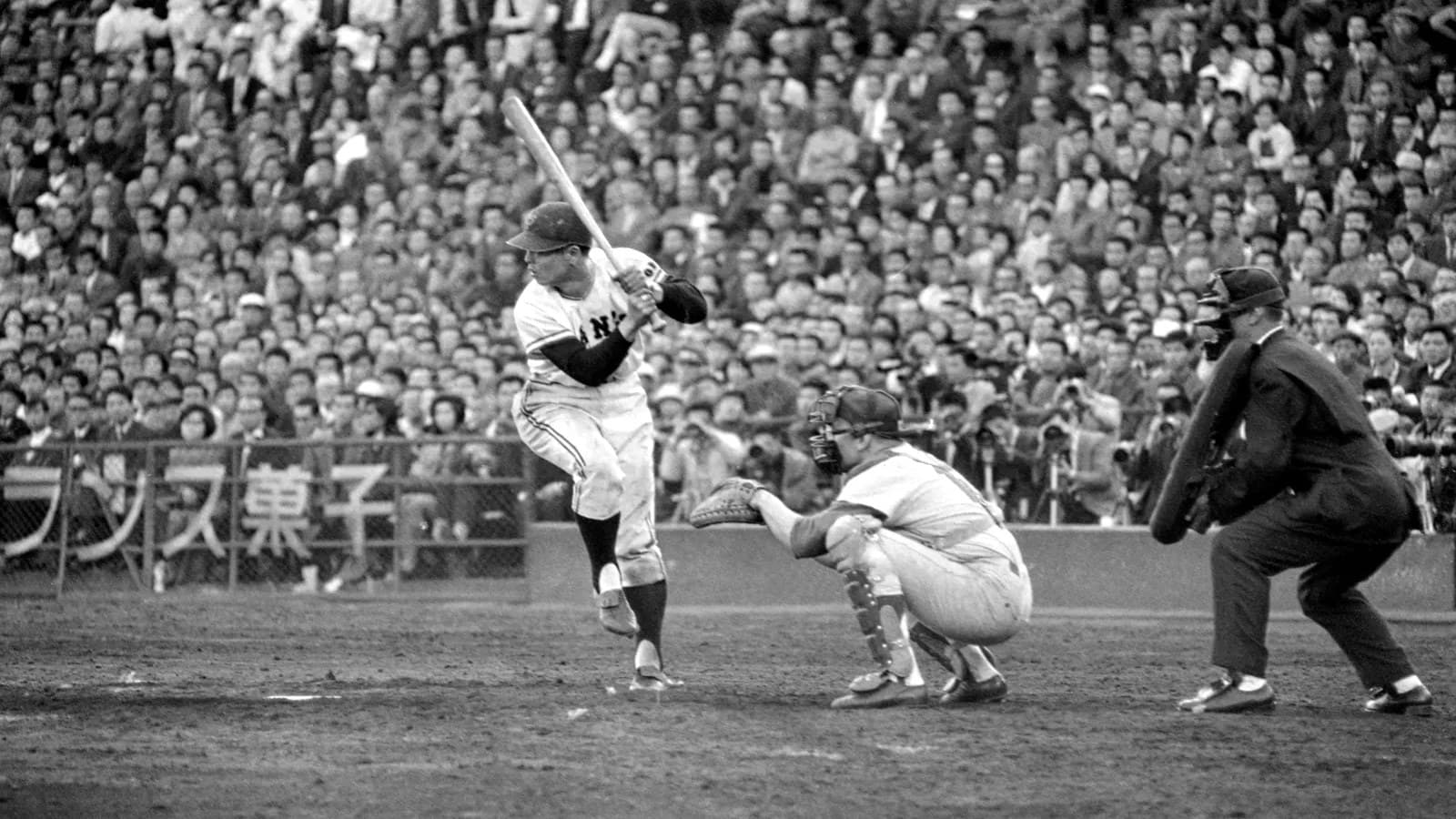
The People Who Made Baseball a World Culture
From Babe Ruth to Shohei Ohtani: the figures who shaped baseball far beyond the sport itself – on the field, in the media, in politics and in pop culture.
A Good Baseball Film Is Never About Baseball
On screen, too, baseball is far more than sport. It is a stage for loss, for memory, for America's story about itself. No other sport has a canon that reaches so far beyond its own fanbase.