Baseball Caps in Hip-Hop: The 10 Most Important MLB Caps in Pop Culture
From Eazy-E through Jay-Z to Kendrick Lamar: how Yankees, White Sox and Dodgers caps became symbols of hip-hop culture – and why baseball still shapes fashion today.

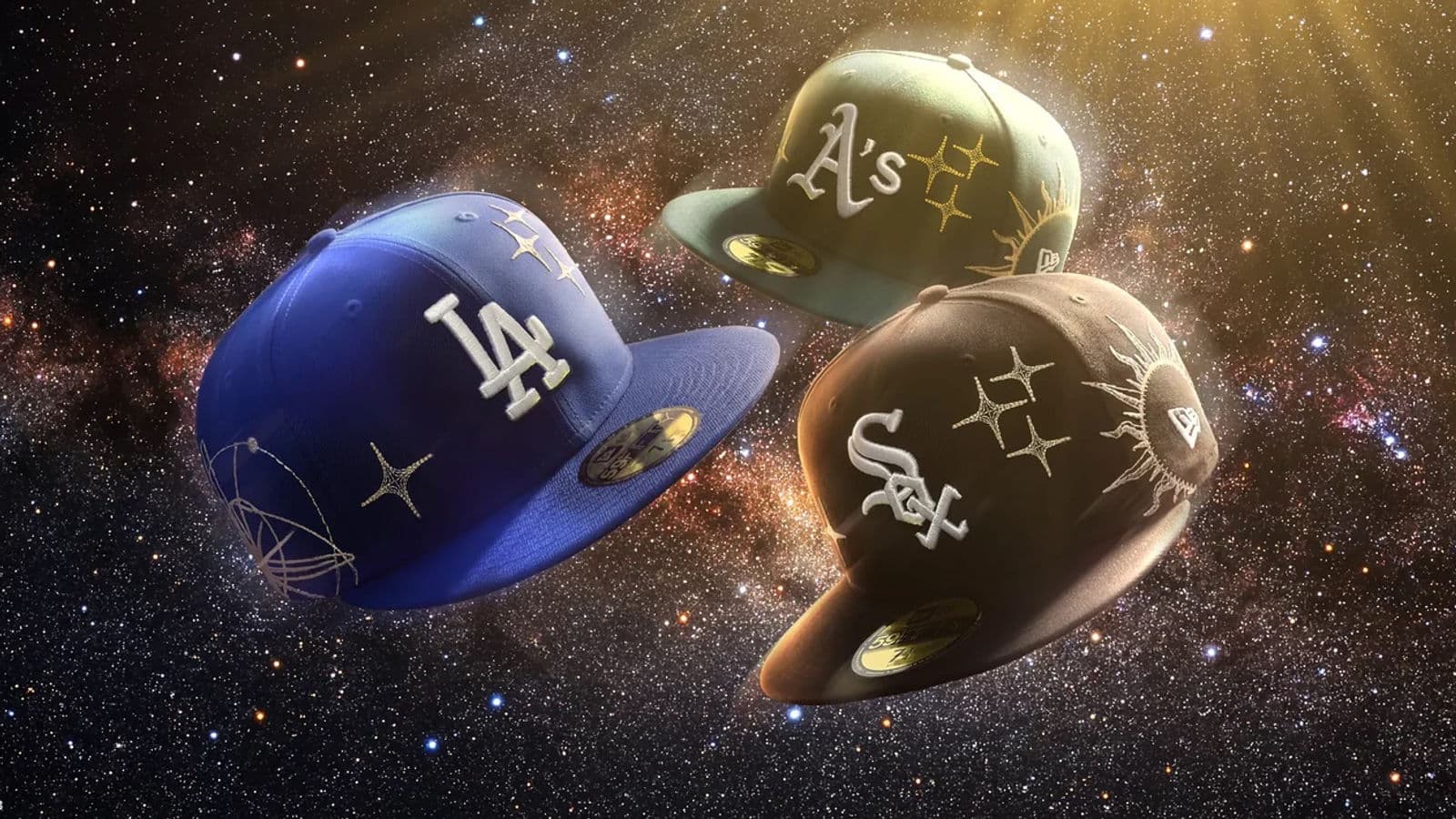
From N.W.A.’s black-and-white White Sox fitted to Spike Lee’s red Yankees cap, hip-hop turned baseball headwear into a portable language for place, identity, and style. Eazy-E wore one because the colors worked. Jay-Z wore one until it became inseparable from his identity. Spike Lee wore a colorway that was not supposed to exist. Decades later, the Museum of Modern Art placed the baseball cap alongside the Champion hoodie and Levi’s 501. The relationship between baseball and hip-hop can be traced through an object small enough to fit inside a backpack. A cap can represent a team, but it can also signal a neighborhood, an allegiance, an attitude, or simply an understanding of proportion and color. Baseball established the form. Hip-hop expanded its vocabulary.
Eazy-E and the White Sox: When the Logo Crossed the Map
In 1990, the Chicago White Sox introduced a new visual identity: a black cap with a compact white SOX mark running diagonally across the front. It was sharp, minimal, and close enough to the black-and-white language of the Los Angeles Raiders to make immediate sense on the West Coast. Eazy-E, Ice Cube, and Dr. Dre began wearing it in photographs and videos. None of them needed a connection to Chicago. The cap worked because its colors, geometry, and attitude fit the world they were building. Ice Cube later explained the choice plainly: “Chicago changed their colors to black and white. It was perfect for us.” The response was dramatic. New Era reportedly produced 9,000 White Sox caps in 1990. A year later, demand had pushed that figure to 544,000. The team moved from 18th in MLB merchandise sales at the end of 1990 to third by August 1991. The White Sox had created a baseball identity; hip-hop turned it into a national symbol. The cap no longer required proximity to the ballpark. It only required the right cultural context.
Dr. Dre and “Nuthin’ but a ‘G’ Thang”: The Fitted Goes Mainstream
When the video for “Nuthin’ but a ‘G’ Thang” arrived in 1992, Dr. Dre appeared in the White Sox cap. The song became Dre’s defining solo breakthrough and introduced Snoop Dogg to a mass audience, reaching No. 2 on the Billboard Hot 100. The White Sox fitted entered millions of homes alongside the sound and visual language of West Coast G-funk. The cap’s popularity had already accelerated through N.W.A., but the video fixed the association in mainstream culture. The black White Sox fitted no longer belonged solely to a team in Chicago or a particular generation of Los Angeles rappers. Tupac, Puff Daddy, Nas, Lil Wayne, and artists across successive eras would wear versions of the same design. A baseball logo had become transferable cultural property. You did not have to follow the standings. You only had to understand what the cap communicated.
Spike Lee’s Red Yankees Cap: The Custom Colorway Arrives
During the 1996 World Series, Spike Lee wanted his Yankees cap to match a red Yankees jacket. There was one problem: New Era only manufactured licensed MLB caps in official team colors. Lee called the company and asked for a red Yankees 59FIFTY with a white interlocking NY. New Era sought approval from Yankees owner George Steinbrenner and Major League Baseball, then produced the custom cap. Lee wore it during the World Series. The reaction changed the licensed-cap business. Until then, an official Yankees fitted was navy because the Yankees wore navy. Lee’s cap proposed a different idea: the logo could remain authentic even when the color became personal. The attention surrounding it helped open the market for fashion colorways, collaborations, and customized team headwear. The Baseball Hall of Fame now describes Lee’s red Yankees cap as a turning point for the fitted-cap industry. He did not redesign the Yankees logo. He changed who was allowed to interpret it.
Jay-Z and the Yankees Cap: When Identity Matters More Than Fandom
Jay-Z grew up in Bedford-Stuyvesant, Brooklyn, across the city from Yankee Stadium in the Bronx. Yet by the late 1990s, the Yankees cap had become almost inseparable from his image. On Jay-Z, the interlocking NY did not function primarily as evidence of baseball loyalty. It worked as a shorthand for New York itself: ambition, scale, confidence, and the ability to turn a local identity into a global one. In “Empire State of Mind,” he claimed to have “made the Yankee hat more famous than a Yankee”—one of hip-hop’s clearest acknowledgments that the cap had outgrown the players who originally gave it meaning. Yankees star Giancarlo Stanton later described the symbol as something “bigger than baseball,” with the players serving as “the icing on top.” By then, the cap was no longer simply merchandise. It was biography: something a person could wear to explain where they came from—or who they intended to become.
Nelly and the Cardinals: The Power of Real Allegiance
Many of hip-hop’s most famous baseball caps were worn by artists with no meaningful relationship to the team on the front. Nelly offers the counterargument. He came from St. Louis and grew up supporting the Cardinals. When he wore the Cardinals cap in videos, on tour, or on the red carpet, it was not a borrowed aesthetic or an abstract color choice. It meant home. That distinction matters. The cultural power of a baseball cap does not depend on separating it from the sport. Genuine loyalty, worn consistently and without performance, can be just as visually influential as deliberate appropriation. Nelly’s Cardinals cap worked because the symbolism had not been emptied out. The team, city, artist, and personal history all pointed in the same direction.
Chance the Rapper and the White Sox: The Circle Closes
A quarter-century after N.W.A. adopted the White Sox cap from nearly 2,000 miles away, Chance the Rapper approached the same logo from the opposite direction. Chance was born in Chicago, grew up with the White Sox, and regularly wore the team’s caps onstage and in public. In 2016, he became an unofficial envoy for the club, narrated a new ballpark introduction, and worked with New Era and the White Sox on three redesigned caps. He also threw the ceremonial first pitch at the home opener. The collaboration connected a hometown artist directly to his team’s visual identity. The cultural loop was complete. N.W.A. had selected the White Sox cap because it worked outside Chicago. Chance returned it to the city as someone who understood both sides of its meaning: the original baseball allegiance and the cultural life hip-hop had created around it. This time, the team was not watching from the sidelines. It was part of the collaboration.
Kendrick Lamar and the Dodgers: The Cap as Local Language
When Kendrick Lamar threw the ceremonial first pitch at Dodger Stadium in April 2015, he appeared in Dodgers gear. For an artist from Compton whose family had moved west from Chicago, the choice carried more than one layer. Los Angeles hip-hop had long moved between White Sox and Dodgers imagery: one adopted through the visual codes of N.W.A., the other rooted in the city itself. Kendrick’s Dodgers cap placed him firmly in the present tense of Los Angeles. It connected Compton to Chavez Ravine without pretending those places shared the same geography or experience. MLB described him at the time as a diehard Dodgers fan, but the image communicated even to people who knew nothing about his fandom. That is the efficiency of the baseball cap. A jersey occupies the body. A cap punctuates it. Two letters can function as a map.
Beyoncé, the Astros, and the Yankees: The Freedom Not to Choose
Beyoncé is from Houston, which gives the Astros cap an obvious biographical meaning. Her life with Jay-Z also connects her publicly to New York, where the Yankees cap carries a different but equally legible set of associations. She has worn both. Baseball caps accommodate this kind of layered geography more easily than most team apparel. An Astros cap in Houston and a Yankees cap in Manhattan do not necessarily cancel each other out. One can represent origin; the other can represent context, family, or the city a person occupies at that moment. Whether either look qualifies as traditional fandom is almost beside the point. The cap can hold several versions of the same person without demanding that one invalidate the others. That is not indecision. It is exactly the kind of complexity the baseball cap has learned to carry.
Supreme x New Era: The Baseball Silhouette Without a Team
James Jebbia opened Supreme on Lafayette Street in downtown Manhattan in 1994. The shop became a meeting place for New York skateboarders, artists, and the wider downtown counterculture. Hip-hop was part of its environment from the beginning. Supreme’s relationship with New Era took the logic of the fitted one step further. In 2006, the brands released 59FIFTY caps that placed Supreme’s rectangular Box Logo where a baseball team’s insignia would normally sit. “World Famous” appeared on the back. The construction remained closely associated with Major League Baseball. The symbol no longer referred to a team, a city, or a season. Supreme did not invent the cap as streetwear, and it did not begin making New Era fitteds in 1994. What it did was demonstrate how completely the baseball silhouette could function without baseball. Its early New Era releases preserved the fitted structure while replacing the team identity with a brand. Artists including Tyler, the Creator, Travis Scott, and A$AP Rocky wore Supreme caps as part of a cultural system shaped by drops, scarcity, and recognition. Baseball had provided the architecture. Streetwear built a different institution inside it.
MoMA and the Yankees Cap: From the Dugout to the Design Canon
In 2017, New York’s Museum of Modern Art opened Items: Is Fashion Modern?, an exhibition built around 111 objects that had altered the way people dress and understand clothing. The Levi’s 501 was there. So were the Champion hoodie, the graphic T-shirt, the little black dress—and a New Era Yankees cap. This was not Cooperstown and not an exhibition about baseball memorabilia. The cap appeared inside one of the world’s most influential modern art institutions, treated as an object of design and cultural history. “The exhibit epitomizes what has been essential to our culture,” MoMA merchandising director Chay Costello said at the time. New Era’s Yankees cap remains represented in the museum’s collection. By then, the old distinction between sports equipment and fashion object had become impossible to maintain. The baseball cap was both—and had accumulated several other identities along the way. Hip-hop did not simply borrow the cap from baseball. It freed the object from the requirement that its wearer care about the team, while preserving everything a team logo could already carry: place, rivalry, aspiration, memory, and belonging. Baseball built the form. Hip-hop taught it how to travel.
Read on

A Good Baseball Film Is Never About Baseball
On screen, too, baseball is far more than sport. It is a stage for loss, for memory, for America's story about itself. No other sport has a canon that reaches so far beyond its own fanbase.
The People Who Made Baseball a World Culture
From Babe Ruth to Shohei Ohtani: the figures who shaped baseball far beyond the sport itself – on the field, in the media, in politics and in pop culture.