Pure Handmade: Baseballs 3x3 is 5
No bat, no glove, no pitcher. Baseball5 needs a rubber ball and 21 metres of asphalt. The game comes from the streets of Havana, was re-measured in a federation headquarters and has just awarded its first gold medal under the five rings at the Youth Olympic Games.
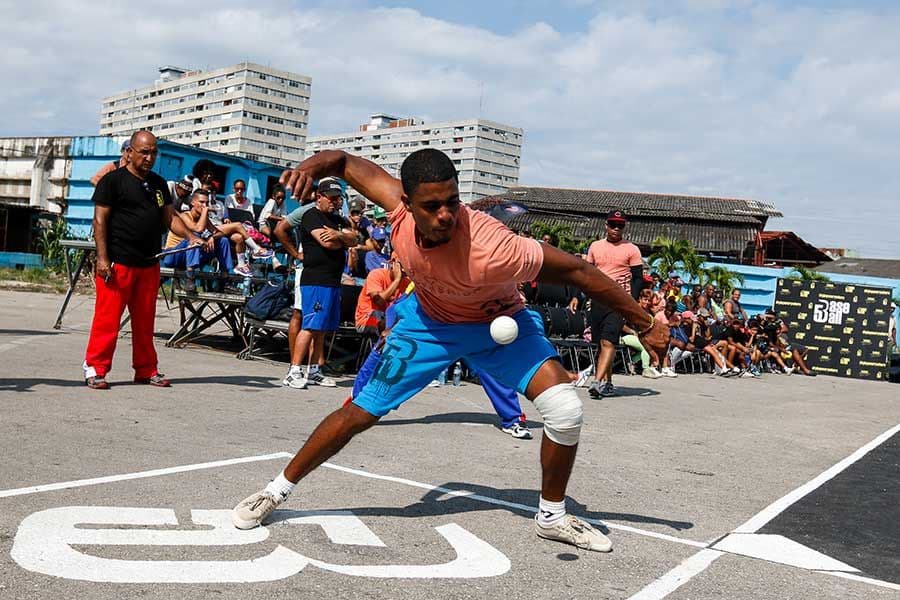
The ball is made of rubber and fits in a jacket pocket. Whoever is up to bat first raises the hand they intend to hit with. The rules require it. Then they toss the ball up briefly and drive it into the field with a fist or an open palm. No wood, no aluminium, no leather. Then they run.
Complexe Tour de l'Œuf, Dakar. Next door are the courts for 3x3 basketball and breaking, a few steps further on the new skatepark. In the middle of it all, a square with four bases marked on the ground. Rachel Medina, Jean Carlos Machado and six other teenagers from Cuba are playing the final here. The opponent is Chinese Taipei. Cuba wins in two sets, 2-1 and 7-1, and takes the first gold medal ever awarded in this discipline under the Olympic rings. Medina is named one of the tournament's two MVPs, alongside Mexico's Isaac Rodríguez.
Two days earlier, the same Cuban team had lost to the same opponent, 3-5 and 4-5. It was the first defeat for a Cuban team at a world federation tournament or under the Olympic rings since Baseball5 has existed. Afterwards Medina said: "We lost a game, but not the war."
Dakar 2026 is the Youth Olympic Games, not the big Summer Games. Around 2,700 athletes, all of them teenagers. Still, it is a premiere of real weight: the first Olympic event on African soil. Baseball5 opened it. On 30 October, one day before the opening ceremony, Türkiye versus Cuba was the very first competition of these Games. The first sport Africa saw under the five rings was a street game from the Caribbean. Baseball5 is not on the programme of the big Olympic Games. Not yet, at least, though the road no longer seems long. To understand how it got here in the first place, you have to start in Havana. On the asphalt, to be precise.
Four Corners
In Cuba the game is called Cuatro Esquinas, four corners. Or simply Pelota a la mano, ball by hand. It emerged at some point in the last century as the answer to a practical problem: baseball is expensive. It needs bats, gloves, balls, a big field and 18 people. In the barrios, apart from the people, there was not enough of any of it. So the core was all that remained. A ball made of rubber or cloth, the four corners of an intersection or a courtyard, a hand.
It was played everywhere. On the street, in the schoolyard, on concrete lots, in the living room if need be. The rules changed from neighbourhood to neighbourhood. In one common variant, four players per team take the field, three in the back, one at first base. The ball has to be hit low, as close to the asphalt as possible. In some neighbourhoods, runners were only allowed to walk the bases, not run them.
Nobody knows exactly how old the game is. In 2020 three Cuban sports scientists tried to set out its foundations in the journal Ciencia y Deporte, and the first thing they found was that there is no literature. No origins, no precursors, nothing written down. Their conclusion: Cuatro Esquinas is the most widespread traditional game in the country, ahead of marbles and spinning tops, and deserves recognition as intangible cultural heritage. A game an entire island knows, and one nobody ever wrote down.
Street games are oral culture. They are not taught, they are copied. Anyone who grew up in Cuba before smartphones played Cuatro Esquinas, the way kids in Germany kicked balls against garage doors. The state news agency Prensa Latina describes it as the game of a time without mobile phones, computers and video games.
That time is ending in Cuba too. Football has gained ground in the barrios, and Messi and Ronaldo have long been big names there. Baseball, once a matter of state, has lost talent, money and lustre. Even the game played by hand was no longer a given by the time it became an export.
The Relatives
Cuba did not invent the principle alone. Wherever baseball grew big and space was tight, the game shrank.
In New York it was called stickball and punchball. Stickball was played with a broomstick, punchball with a fist and no pitcher. The ball was a pink rubber ball made by Spalding, which kids on the streets of Brooklyn and the Bronx called a "Spaldeen". Manhole covers were bases, parked cars foul territory. In the Dominican Republic they play vitilla, with a broomstick and the plastic cap of a water jug. In Venezuela the variant is called pelotica de goma, little rubber ball. It is more than 70 years old.
Baseball is seen as a sport of diamonds, manicured grass and scoresheets. Its folk culture, though, always happened somewhere else. On concrete, with improvised equipment, under rules negotiated on the street corner. The ballfield was the exception. The street was the rule.
In the United States, that culture is largely a memory. Stickball lives on in nostalgia leagues and old photographs. In the Caribbean it is still alive, because the reasons it arose in the first place still apply there.
On the Drawing Board
In 2017 the World Baseball Softball Confederation takes up the game. The world governing body, WBSC for short, is based in Switzerland and has a problem. Baseball and softball dropped out of the Olympic programme after 2008 and came back only as hosts' optional sports. Tokyo wanted them, Paris did not. The sport is seen as expensive, slow and confined to a handful of countries.
Riccardo Fraccari, an Italian and president of the WBSC, goes looking for an answer and finds it in Havana. Cuatro Esquinas becomes Baseball5. Five against five, five innings, a brand with a hashtag: #PlayEverywhere. The launch takes place on the street next to the Estadio Latinoamericano in Havana, with students from four of the city's universities. The first tournament follows there in November 2017. It doubles as the finals of the national Cuatro Esquinas championship, organised with the Cuban sports authority INDER. That weekend, the old game and the new one literally share the same ground.
In 2018 the WBSC publishes the rulebook. It reads like a fair copy of a street game. The field is a square 21 metres on each side. Fraccari chose the size deliberately: it was meant to fit on a basketball court, so the game really could be played anywhere. The bases are 13 metres apart and painted on the ground. As in coach pitch or youth baseball, first base is doubled so runners and fielders don't collide. There is no pitcher and no catcher. The batter puts the ball in play themselves, with a fist or an open hand. The ball has to land beyond a diagonal line in front of home plate. The area in front of it is called the no-hit zone. A home run over the fence does not exist. Three outs, switch sides, and after five innings a set is over. That takes 15 to 20 minutes. In tournaments, whoever wins two sets wins the game.
Some rules show how closely the authors watched. A batted ball has to carry enough momentum to reach the fence at the end of the field. Just tap it and you're out. The bunt, an art form in baseball, is abolished here. The game is supposed to keep moving. Ahead of the 2022 World Cup the rulebook was tightened, the bases grew from 50 to 60 centimetres per side and moved out a little. Since then the rules, along with a toolkit for teachers and coaches, have been available in several languages as free downloads. That is part of the concept too. A game meant to be played everywhere must not cost anything, not even the instructions.
Five on the field, eight on the roster. Women and men play together, on the same team, in the same lineup.
Fraccari has spelled out the logic openly to MLB.com. Put a kid in right field in baseball, he said, and they'll see a ball every ten minutes. That's no way to win anyone over. Baseball5 strips away everything in the game that waits. No count, no pitcher-batter duel, no pauses on the mound. What remains is contact, defense and pace. Every ball is in play. Every player is involved.
You can read this as simplification. You can also read it as a teardown, an excavation of what baseball was before it built itself stadiums.
The Man with the Fastest Hand
The face of the new game is Cuban. Briandy Molina grew up playing Cuatro Esquinas on the street and became Baseball5's first star. In 2019 he captained Cuba to victory at the Americas Open, ran coaching clinics in half a dozen countries including China, Thailand and Iran, and said on the world federation's podcast that Baseball5 was "the most beautiful thing that has ever happened to me".
For the discipline's fourth birthday in 2021, the Cubans held a skills competition. The fastest runner went from home plate to first base in 2.02 seconds. Molina hit the hardest ball. It was clocked at 74 miles per hour, around 119 kilometres per hour. By hand.
At first glance Baseball5 looks like a schoolyard game. At the top level it is a sport for infielders with sprinters' legs. The distances are short, reaction times minimal, a double play takes just over two seconds. Hesitate and you're late.
Molina's counterpart in the big finals was a Japanese woman. Ayako Rokkaku was voted best player at the first World Cup in 2022 and best coach at the same time, because she led her team as player-coach. In Dakar she appeared as a role model for the next generation.
Two MVPs and a Third
Baseball and softball are separate worlds. Their own leagues, their own fields, their own balls, for decades their own federations too. Baseball5 does away with that separation without making much fuss about it. There is no men's and no women's ranking. There is one team.
That changes how the game looks and how it is told. At the 2022 World Cup the world federation for the first time in its history awarded two equal MVP titles, one to a woman, one to a man. It has stayed that way. In Hong Kong it was Haila González and Briandy Molina, in Taranto Yağmur Bozdağ and Frenchman Lucas Dedieu, in Dakar Rachel Medina and Isaac Rodríguez. Since then, a pair has stood at the front of every medal ceremony.
On top of that comes a third award: the #B5High5 Award for the "Social MVP", the best work on social media. In 2022 it went to Japan's Takeru Miyanohara, in 2024 to the Japanese federation. A prize for reach, handed out on the podium. It would be hard to say more clearly which audience this game is meant for.
In Dakar, six Baseball5 players carried their country's flag into the Stade Abdoulaye Wade at the opening ceremony. A remarkable share for a discipline just nine years old. Among them were Kenya's Winfridah Msavi and France's Elsa Lepinay, who said beforehand that she also wanted to use the moment to make her sport better known.
Zócalo, Waterfront, City Park
Where a sport plays says what it wants to be. Baseball5 has consistently put its big tournaments where there is no ballpark.
The first World Cup took place in November 2022 on the Zócalo, the central square of Mexico City, in front of the cathedral and the National Palace. More than 2,000 people watched Cuba beat Japan in the final. With Kenya, South Africa and Tunisia, three African teams took part in a federation world championship for the first time.
Since then Mexico has become one of the countries where the game has spread most quickly. In Navolato, in the state of Sinaloa, a stronghold of Mexican baseball, there is an established scene whose teams travel to national tournaments in Acapulco, Monterrey and Cancún. In June 2025 Briandy Molina came there to run a clinic. In September of the same year Mexico hosted the second Youth World Cup. In Dakar the Mexican squad took bronze. Isaac Rodríguez finished the tournament with 67 hits and a batting average of .761.
The second World Cup was played in October 2024 in Hong Kong, on an event space at the Central Harbourfront with the skyline at its back. Cuba against Japan again, Cuba again, 16-1 and 7-5. Molina was MVP once more, this time together with his teammate Haila González.
In summer 2026 came the Mediterranean Games in Taranto. The venue was the Villa Peripato, a city park. And in Dakar, Baseball5 shared the Complexe Tour de l'Œuf with basketball players, breakers and skaters. The third World Cup begins on 8 December in Carolina, Puerto Rico, with 16 teams for the first time. The court stands at the Balneario de Isla Verde, a public beach.
Squares, harbours, parks, beaches. That is the programme. The discipline seeks the company of the urban sports, not of baseball. It wants to be seen next to 3x3 and breaking. In the world federation's tournament reports there is no talk of a field. It is a court.
The Calculation
Behind all this, not least, lies a pragmatic calculation. It has to do with the International Olympic Committee. For years the IOC has favoured formats that are young, short, urban and mixed-gender and that need little infrastructure. Basketball showed how it's done. 3x3 debuted in 2010 at the first Youth Olympic Games in Singapore and was Olympic in Tokyo eleven years later. Breaking auditioned in 2018 at the Youth Olympics in Buenos Aires and was on the programme in Paris in 2024.
Baseball5 meets the criteria almost by the textbook. Eight players instead of 24. A court instead of a stadium. Mixed teams. A set in 20 minutes. Because the discipline was introduced in every country at the same time in 2017, no nation has a head start of decades. That was one of the charges against baseball at the Olympics: too few countries capable of winning.
The world ranking confirms this in an almost comic way. The United States, baseball's motherland, sat in a shared 49th place out of 66 ranked nations at the start of 2026. USA Baseball promotes the young discipline as "the hip, new partner of America's Pastime". It is played elsewhere. In Cuba, in Taiwan, in France, in Tunisia, in Lithuania, in Kenya.
Fraccari calls Dakar another step. For now, that is all it is. Baseball and softball return in Los Angeles in 2028, Baseball5 is not part of it. Whether they will be in Brisbane in 2032 is open. Baseball5 is the federation's insurance against the next exit. The discipline was on the programme of the Southeast Asian Games in 2025 and a demonstration sport at the Mediterranean Games in 2026, and an agreement with the international school sport federation has been signed. According to the federation, there are programmes in more than 100 countries.
IOC President Kirsty Coventry came to the court the morning after the opening ceremony and watched Chinese Taipei beat Cuba. You could see the youthful energy, she said afterwards, and spoke of opening urban sports up to the world. For a trial run, that is a clear signal.
Baseball's 3x3
The comparison is so obvious that in Dakar it became spatial. Baseball5 and 3x3 basketball played in the same complex, a few metres apart. One discipline has the journey behind it, the other still ahead.
3x3 was once streetball. One hoop, half a court, three against three, music at the sideline. The basketball world federation turned it into a format with rules, a world ranking and a tour, tested it at the 2010 Youth Olympics and brought it to the big stage in Tokyo in 2021. Since then it has been a fixed part of the programme, and it is planned for Brisbane 2032 as well. 3x3 took nothing away from basketball. It opened a second door, for countries that would never stand a chance in five-on-five and for an audience that doesn't buy arena tickets.
That is exactly what Baseball5 can become for baseball. In the Olympic world the discipline is considered one of the hottest candidates for future Summer Games. The arguments are the same as they were for basketball back then, and some carry more weight. The IOC caps the Games at around 10,500 athletes. A baseball tournament needs two dozen players per team and a stadium. A Baseball5 tournament needs eight per team and a space that already exists in every city. Add to that something 3x3 does not offer: women and men on one team.
Fraccari set the direction early. As far back as 2021 he wrote that the goal was not merely participation in Olympic events but a lasting contribution to the Olympic movement. Baseball5 fits the IOC's reform ideas, he argued, because it requires neither special equipment nor dedicated venues.
There is one difference, though. Basketball is a core Olympic sport, and 3x3 came on top. Baseball is not. It has to apply anew with every host. Officially, the world federation is campaigning for baseball and softball in Brisbane. Still, the model shows where the journey could lead. In basketball the formats don't exclude each other. Five against five in the arena, three against three on the court, both Olympic, both with their own medals. Applied to baseball, that would mean baseball, softball and Baseball5 side by side on the programme. The big game in the stadium, the small one on a court downtown. Not either-or, but a family of disciplines reaching different countries, different places and different spectators. Baseball5 would then take nothing away from the classic game. It would be the strongest argument that the sport as a whole belongs.
Nothing has been decided. But anyone who watched in Dakar how naturally the rubber ball sat next to basketball, breaking and skateboarding has an idea of what that would look like.
Montpellier, Panevėžys, Ankara
Anyone who reads Baseball5 only as an Olympic lobbying product, however, completely misses how much it has taken on a life of its own in many places. In Europe, a pecking order of its own applies. The Netherlands and Italy, which have dominated the continent in the classic game for decades, play supporting roles here at best. The power is France.
The French federation was in from the start. In 2018 it opened in Montpellier what it describes as the first purpose-built Baseball5 court in Europe. Today the national performance centre CREPS there houses a Pôle France Baseball5, a boarding programme for 14- to 19-year-olds with school, a strength and conditioning coach and its own court. France became the first European champion in 2020, won World Cup bronze in 2024, became the first European nation to top the world ranking in November 2023 and took back the European title in 2025, unbeaten, with a run tally of 149-13. Federation president Didier Seminet said after the first title that a mixed team sport was exactly what had been missing to make the sport more popular in Europe.
The second centre of gravity is Lithuania. All three European Championships so far have taken place there, in Vilnius in 2020, Druskininkai in 2023 and Panevėžys in 2025, the last of them in an arena with 5,600 seats and 15 nations. In 2023 the hosts won the title. The third is Türkiye, which hosted the first Youth World Cup in Ankara in 2023, beat France in the final in Taranto in 2026 and, in 17-year-old Yağmur Bozdağ, has one of the most striking players on the continent.
There is now a club competition as well. The first Baseball5 European Cup was won in July 2025 in Sofia by BK Vilnius. France sent the Tigers from Thiais, a suburb south of Paris. These are names nobody in European baseball had on their radar.
France, Lithuania, Türkiye. None of these countries has a baseball tradition that goes beyond a niche. That is precisely why it works there. Where nobody misses a ballpark, nobody minds that none is needed. A sports hall will do. A schoolyard will do.
Where things are heading could be seen in southern Italy in mid-November. A good week after the final in Dakar, Europe's youngsters played for the Youth European Championship title in Policoro, Basilicata. 13 nations, 54 games on two courts in the PalaErcole, three places at the 2027 Youth World Cup. France, Lithuania, Spain and Türkiye were there, as were Hungary, Croatia and Ukraine, which are only just starting out internationally. Germany was missing from the field.
In Germany little of all this has arrived so far. The world federation presented the discipline at the general assembly of the German Baseball and Softball Federation (DBV) in Frankfurt shortly after the rules were published. The first German championship took place in February 2024 at the Berlin Sluggers, as a youth tournament with eight teams and just over 60 players. In the final, Rocket Five beat a team called Five Fingers Death Punch. The team name says more about the tone of this game than any rulebook.
Azraq
Around 100 kilometres east of Amman, in the Jordanian desert, lies the Azraq refugee camp. It opened in 2014. More than 40,000 people who fled the war in Syria live there, about half of them children.
In 2023 the WBSC brought Baseball5 to the camp, together with the humanitarian foundation of World Taekwondo and with support from the UN Refugee Agency. Two courts were laid out. Nothing more was needed. A baseball field in a refugee camp would be a construction project. A Baseball5 court is paint on concrete.
The programme became a team. In February 2024 Reem Hadroos became the first resident of the camp to be certified as a coach and umpire. In August 2024 the team travelled to Paris and played France's national team on the sidelines of the Olympic Games. Fraccari later recounted that he had asked the teenagers what the game meant to them. Most of them, he said, answered that it gave their day a purpose.
In 2025 the team played at the Youth World Cup in Mexico. In July 2026 it competed for Syria in Taranto and beat Greece for its first-ever international win. Then came Dakar. Syria, ranked 46th in the world, lost all three group games. On the final day it played host nation Senegal for seventh place. First set 3-1 to Syria, second 0-8, one player had to leave the field ill. Third set 6-4.
It was the third win in this team's history. The families followed the game from the camp over the internet. Among the spectators was Thomas Bach, honorary president of the IOC and president of the Olympic Refuge Foundation. Afterwards he spoke of sport as it should be. The Tunisian coach Chedli Mokrani said: "For them it is a dream to be here and to play."
You could dismiss stories like this as federation folklore. The world federation tells them often and gladly. But the teenagers from Azraq really did stand in Dakar, with accreditation, with jerseys, with a win.
Falcons
The second surprise of Dakar came from East Africa. Kenya, ranked tenth in the world, won all three group games, against France, Mexico and Syria, and went straight through to the semi-finals as group winners. Against Mexico it was 6-5 twice.
Kenya's flag bearer at the opening ceremony was Winfridah Msavi. A year earlier she had been a handball player. A coach had spotted her on the handball court. Asked about the ground her team trains on at home, she described a rough surface that had made the squad resilient. Before departure there had been reports in Kenya that the team lacked suitable training facilities.
The Kenyans call themselves the Falcons and have their own anthem, which they sing after wins. In it they declare themselves kings of the sky and the pride of Africa. In the semi-final Cuba was too strong, and in the bronze-medal game Mexico reversed the group-stage result. Kenya finished fourth.
Kenya is not a baseball country. There is no league of any note and no tradition. But there is Baseball5, at least since the first World Cup in 2022. There is a world federation programme in the Kakuma refugee camp in the country's northwest, home to almost 290,000 people. Tunisia sits in the top five of the world ranking. South Africa, Ghana and Zambia have national teams. Tanzania hosted the African Championship in 2022, with ten teams.
Host nation Senegal lost every game in Dakar. In the group stage they ended up with 10 runs scored against 79 conceded. The first of them was scored by Ahmadou Mbengue. That, too, is a line for a history book that is only just being started.
Africa is the continent where the game's promise holds most literally. Where a baseball glove is unaffordable for most people, a sport without a glove is no marketing idea. It is the only option.
Who Owns the Game
Cuba has won every world title since 2022. Two World Cups, two Youth World Cups, and now the Youth Olympics. Cuban baseball is in crisis. In the discipline from its own back streets, the island is the undisputed number one. The 2022 world champions were voted team of the year at home.
And yet the most important news from Dakar was a Cuban defeat. Chinese Taipei won 5-3 and 5-4 on 1 November. Two sets, two runs' difference, the end of invincibility. Cuba responded like a champion, beat France, beat Kenya, beat Taipei in the final. But the big gap is gone.
The challenger is Taiwan. The squad, which competes internationally as Chinese Taipei, finished third at the 2022 World Cup, has won the Asia Cup several times, reached the final of the Youth World Cup in 2025 and is listed second in the world ranking. Taiwan is a baseball country, for young players too. The U12 Baseball World Cup is held there every two years. It is a country with a professional league, with school baseball and with an infield school of thought that suits Baseball5. In Dakar it won its group unbeaten, with a run tally of 48-14.
For a street game, this is the real test. As long as Cuba wins everything, Baseball5 remains Cuatro Esquinas with a logo. Once Taiwan, Mexico, France or Kenya can win, it has become something of its own. A game that takes root in many places at once and sounds a little different in each. In Kenya with a falcon anthem. In Azraq with families in front of a livestream. In Berlin with team names pulled off the metal shelf.
Street culture, however, cannot be designed on a drawing board. The WBSC has a rulebook, a world ranking, a hashtag and an Olympic goal. That is not culture. Culture emerges when teenagers leave the court and keep playing at the next corner without an umpire. Under rules they change themselves whenever they need to. When variants arise in Montpellier, Taipei or Mombasa that are in no rulebook. Culture expresses itself in clothing, gestures, language.
But the conditions are better than for almost any other invented format. Baseball5 was not invented, it was found. The federation measured a game that had long existed. And it sent it back to where such games come from. To squares, to courtyards, to asphalt.
In Cuba, scientists are calling for Cuatro Esquinas to be declared cultural heritage. The game nobody ever wrote down now has a rulebook in several languages and a gold medal from the Youth Olympic Games. On the streets of Havana, it is still played without either.
Baseball took a century and a half to build itself stadiums. For the way back to the street, a rubber ball was enough.
Read on
Baseball Caps in Hip-Hop: The 10 Most Important MLB Caps in Pop Culture
From Eazy-E through Jay-Z to Kendrick Lamar: how Yankees, White Sox and Dodgers caps became symbols of hip-hop culture – and why baseball still shapes fashion today.
Baseball Culture: The Invisible Game Within the Game
Baseball is a game of ritual, memory, migration and belonging. An essay on why its culture continues long after the final out.
Murakami, Bananas, 1000 Games: Baseball Is Having Its Moment
Munetaka Murakami leads MLB in home runs. The Savannah Bananas are filling major stadiums. In Hamburg, the Stealers are celebrating their thousandth game. Baseball in 2026 is having its moment.