Baseball between ruins and dreams
Baseball came to Tampa Bay in 1887, long before anyone talked about the major leagues. In 2026 the Rays reach the World Series for the third time and lose it for the third time. The question of where they belong is still open.
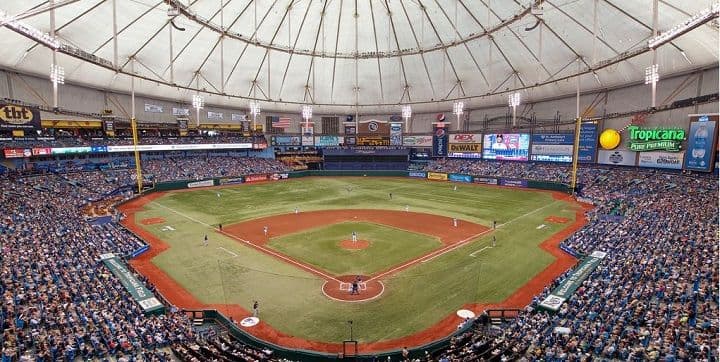
Tropicana Field, St. Petersburg, Monday, October 19, 2026
Seventh inning, Game 6 of the ALCS. Junior Caminero hits a home run off the left-field foul pole, two runs. The building shakes. He runs to first base and stops. Then he keeps going and stops once more just short of home plate. Behind the plate sits Randy Arozarena, a former Ray. Caminero crosses his arms over his chest. It is Arozarena's pose, a special salute. Only then does he step on the plate.
In the next inning Yandy Díaz hits a two-run homer that smothers whatever chance Cleveland had left. The fans chant his name until he comes out of the dugout once more for a curtain call. The final is 7-3. Down 1-2 in the series, the Rays beat Cleveland in six games and win the American League pennant.
The Rays are in the World Series for the third time, after 2008 and 2020. Their opponent is the Milwaukee Brewers, whose 103 wins were the most in the majors during the regular season. Neither team has ever won it. Games 3 through 5 will be played in St. Petersburg.
After the win over Cleveland, manager Kevin Cash stands on the field in the matching T-shirt and cap, calls Díaz over and says: "We've got one more bite! We've got one more bite!" Díaz is holding a tomahawk steak, by now this team's traditional celebration meal. Caminero drops to his knees, looks up, grabs a big Rays flag, runs toward the stands and tries to plant it in the artificial turf. He shouts into the microphone: "Tampa! This is for you!"
After the game Patrick Zalupski, the managing partner, says the claim that nobody in Tampa Bay comes to the ballpark is "complete nonsense." The noise, he says, was the loudest he has ever heard at a baseball game. A sellout crowd of 40,230 celebrates under the roof of the stadium. Nine days later a champion will be crowned under this roof for the first time. It will not be the home team. And in this case, the roof deserves a closer look.
The Roof
The reason lies almost exactly two years back. On October 9, 2024, Hurricane Milton tears the fiberglass membrane off Tropicana Field. The stadium's roof, a fixed dome of translucent fiberglass that cannot be opened, is largely destroyed. The Rays play the 2025 season at George M. Steinbrenner Field in Tampa, the Yankees' spring training home and the ballpark of the Single-A Tampa Tarpons. A one-year stopgap.
The city of St. Petersburg pays $22.5 million for a new roof of Teflon-coated fiberglass, about half of the estimated total cost of $55.7 million. The city council approves it 7-1. Council member Brandi Gabbard says: "I would much rather spend this money on hurricane relief and on the residents of our hardest-hit neighborhoods." And then: "But this is our obligation." By contract, the city must keep the stadium playable. Work begins in July 2025 and is finished in April 2026. On April 6, 2026, the Rays return and beat the Cubs 6-4. The city pays because it has to. Others paid the real price for this stadium long ago.
A Stadium's History
The land on which Tropicana Field stands was once the Historic Gas Plant District, a neighborhood of Black families in St. Petersburg. It took its name from two gas storage tanks whose ground was contaminated. In 1973 the city council declares the area "slum and blight" and promises better housing and light industry. The promise is never kept.
In 1982 the site is proposed for the stadium after other downtown locations were rejected. By 1986, according to the Southern Poverty Law Center, more than 280 buildings have been demolished and more than 500 families relocated. More than 30 businesses close or move. At least three former Black cemeteries are built over, and graves may still lie there. The St. Pete Catalyst puts the number of people displaced at more than 2,000.
"It wasn't all run-down," says Gwendolyn Reese, president of the African American Heritage Association of St. Petersburg. "A lot of people owned their homes, and they were proud of them." It was a mixed-income neighborhood, she says, because redlining, the systematic denial of loans and housing to Black families outside certain areas, forced everyone to live in the same neighborhood.
Louise Macon, "Mama Louise," owns the last house torn down to make room for stadium parking. She had lived in it for 37 years. She dies in 1995 at the age of 81. David Welch, the only Black member of the city council in 1982, opposes the plan and in the end votes for it anyway. He tells the Tampa Bay Times: "You have a moral obligation to the people who were displaced, for what you told them." His son, Ken Welch, is today the mayor of St. Petersburg.
On November 22, 1986, ground is broken for the dome. Also in 1986, MLB Commissioner Peter Ueberroth writes to the mayor that St. Petersburg is "not among the top candidates" in the search for expansion or relocation cities. In 1990 the Florida Suncoast Dome opens, without a team. Five years later, after nearly three decades of failed attempts to bring a club to the region, a group led by Vince Naimoli is granted a franchise. On March 31, 1998, the Tampa Bay Devil Rays play their first home game before 45,369 fans and lose 11-6 to the Detroit Tigers. They lose 99 games that year. "We finished last nine times in our first ten years," says Rick Vaughn, the Rays' former head of communications.
Cuban Roots
But baseball did not arrive with the franchise. Baseball was here long before the Rays. In the late 19th century Cuban cigar workers move from Havana to Key West, then to Ybor City and West Tampa. They bring with them a game that has been popular in Cuba since the 1870s. In 1887 the first local team is formed in Ybor City. Early Cuban clubs in Tampa raise money for Cuba's fight for independence from Spain. The magazine El Pelota, one of the league's sponsors, gives its profits to the Partido Revolucionario Cubano.
In February 1913 the Chicago Cubs arrive in Tampa as the first team to hold spring training there. Nine days later they beat the Cuban Athletics 4-2 before 6,000 spectators at Plant Field. Cigar factory teams play at Macfarlane Park in West Tampa through the 1910s, 1920s and 1930s. In 1938 the Círculo Cubano, the Centro Asturiano, the Italian Club and the Loyal Knights Lodge found the Inter-Social League, which plays on Sundays at Cuscaden Park. "The games always drew," player and manager Andrew Espolito recalled decades later in the Tampa Tribune.
Al López is discovered in a Sunday amateur game. In 1925 Doc Nance offers him $150 a month to play for the Tampa Smokers. López later says: "I would have played for nothing." On September 27, 1928, he debuts for Brooklyn, catches 1,918 games over 19 seasons, and as a manager leads the 1954 Cleveland Indians to 111 wins. In 1977 he becomes the first Tampa native elected to the Hall of Fame. He dies in Tampa on October 30, 2005, at 97. His restored childhood home now houses the Tampa Baseball Museum, whose records count 89 major leaguers who grew up in Tampa and Hillsborough County. One name on that list belongs to a man who has stood in the dugout in St. Petersburg since 2015: Kevin Cash.
The truth, though, is that not everyone was allowed to play. Hipólito Arenas, born in West Tampa in 1907, is shut out of the predominantly white Inter-Social League and spends 13 years in the Negro Leagues. Alex Pompez, who grew up in Havana and Tampa and owned the New York Cubans, is inducted into the Hall of Fame in 2006.
On July 23, 1947, Charlie Cuellar, born in Ybor City, throws a no-hitter for the Smokers against the Havana Cubans, 5-0 at Plant Field. About 8,000 fans are there, and the field has to be roped off.
Across the bay, things are harsher still. In 1914 the St. Louis Browns train in St. Petersburg, thanks to Mayor Al Lang. From 1925 to 1961 the New York Yankees train there, except during World War II. The Cardinals come too.
The white players stay in an upscale hotel. The Black ballplayers have to be driven to the other side of town, to the homes of Black families. Dr. Ralph Wimbish, a Black physician in St. Petersburg, arranges their lodging. Dr. Robert Swain houses Yankees and Cardinals players, among them Bob Gibson and Elston Howard. In early 1961 Wimbish quits. At the end of January he tells a reporter: "The time has come." The St. Petersburg Times, the Associated Press and the New York Times report it the next day. Five days later Yankees co-owner Dan Topping announces that the club is breaking its contract with St. Petersburg and moving to Fort Lauderdale, where all players will be housed together.
The same year, the Cardinals buy a hotel on the bay where all their players live. The game was always welcome in St. Petersburg. For a long time, Black families paid the bill.
A New Beginning
In 2005 the Rays change more than their ownership. Stuart Sternberg buys the franchise for about $200 million. He fires Chuck LaMar and nearly the entire front office and names Joe Maddon manager. In 2008 the Devil Rays become the Tampa Bay Rays, with a sunburst logo and new colors. That season the franchise posts its first winning record, its first division title and its first pennant. The Rays beat the Boston Red Sox in the ALCS and lose the World Series to the Phillies, 4 games to 1. Their attendance still ranks among the lowest in the league.
On September 28, 2011, in the last game of the season, Tampa Bay trails the Yankees 7-0. On September 1 they had been nine games behind the Red Sox. Dan Johnson, hitless in five at-bats since his return on September 15 and batting .108, hits a homer down the right-field line with two outs in the ninth to tie it 7-7. "I was just thinking: stay fair, stay fair," he says later. Shortly afterward Baltimore beats the Red Sox, and in the 12th inning Evan Longoria hits the shot that makes it 8-7. "In eight minutes the world changed," says Alex Rodriguez, watching from the Yankees bench. The Rays are in the playoffs, with fewer than 30,000 fans in the stands.
The franchise's philosophy: if you have less money, you have to think differently. In late summer 2026 the Rays' payroll stands at $116.2 million, 27th in the league. According to a report by Bill Madden, it has usually trailed the Yankees by more than $100 million. On average, about $60 million a year comes in through revenue sharing.
This kind of scarcity also breeds invention. On May 19, 2018, Sergio Romo, a reliever, is supposed to start a game against the Angels. Kevin Cash wants him to pitch an inning or two before left-hander Ryan Yarbrough takes over. Cash's reasoning: the Angels' lineup is right-handed heavy, and the Rays' data show that hitters gain the advantage the third time through the order. Angels infielder Zack Cozart calls it "bad for baseball." The opener has nevertheless arrived in the baseball world.
Catwalks and Stingrays
Within that baseball world, Tropicana Field is one of the more unusual buildings. The dome is a translucent membrane over a tensegrity structure. Rings, the catwalks, hang beneath the roof. The A-ring is entirely in play. If a ball between the foul poles hits the C- or D-ring, it is a home run. Beyond right-center field lies a 35-foot, 10,000-gallon tank in which three species of rays swim. José Lobatón landed a walk-off homer in it on October 7, 2013. Only since 2021 has a net kept balls from falling in.
Since 2019, when the upper deck was closed, regular capacity has been 25,025. For Game 1 of the Division Series against the Yankees, the upper deck is open again. 40,542 fans, the most since Game 5 of the 2010 ALDS. Drew Rasmussen allows one hit in eight innings, 1-0. "That was the loudest environment I've ever experienced in a ballpark," says Cash. Shortstop Taylor Walls feels the Rays fans drowned out the Yankees fans, unlike most Yankees visits.
But the stadium remains a constant issue for the Rays. In March 2025 Sternberg pulls out of the stadium project that was to be built next to Tropicana Field. $1.3 billion, $600 million of it from the public coffers of St. Petersburg and Pinellas County. He cites the hurricanes and the delays. Mayor Ken Welch says: "I really thought we had it. I have no interest in working with this ownership group. That bridge is burned."
On September 22, 2025, MLB owners unanimously approve the sale to a group led by Jacksonville real estate developer Patrick Zalupski, for a reported $1.7 billion. Sternberg initially keeps a minority stake of about ten percent.
The New Home
In August of this year the Hillsborough County Commission votes 5-2 for a new stadium in Tampa, one day after the Tampa City Council (4-3). It is to be built on Hillsborough College's Dale Mabry campus, next to Steinbrenner Field, where the Rays played in 2025.
Total cost: $2.36 billion. Hillsborough County contributes $796 million, the city of Tampa $80 million, the Rays about $1.37 billion plus all cost overruns. The plan is a fixed-roof stadium with at least 28,000 seats. The county keeps ownership, the Rays pay $4 million a year in rent, and the use agreement runs 35 years and includes a non-relocation clause. Opening: Opening Day 2029, if everything goes to plan. The Rays' use of Tropicana Field ends after the 2028 season.
"Forever starts now," says Zalupski. He tells the Tampa Bay Times that Tampa is "the 11th-largest media market in the country" and that the new stadium will allow the club to raise its payroll. Most of the region's roughly 3.5 million residents live in Tampa, not St. Petersburg.
For Tampa it is a gain, for St. Petersburg a loss. In October 2025 local investors presented a proposal for the 86-acre Gas Plant District site, with or without the Rays. As early as March 2025 Mayor Welch said the Rays' withdrawal would not stop the development residents have been waiting on for some 40 years. Whether the promises of 1973 will be kept this time remains to be seen.
In 2026 the Rays won 98 games and lost 64. It is their first division title since 2021 and the fifth in franchise history. In the Division Series they sweep the Yankees 3-0. They were the first team to clinch a playoff spot, on September 11. They locked up the AL East on September 22 with a 6-1 win at Yankee Stadium. It is the first season under Zalupski. Freddy Peralta came over from the Mets on August 2. He is named ALCS MVP, allowing one run in Game 6 and throwing six shutout innings in Game 2. Erik Neander, president of baseball operations, says: "A team like this, a night like this, that shows what's possible here."
Here. In a building whose roof was taken by a storm and whose ground once belonged to people's homes. Between St. Petersburg, which has paid for a stadium, and Tampa, which now wants to pay for one.
A Road Game Under Their Own Roof
In Milwaukee the Rays lose the first two games, 3-2 and 5-4. On Monday, October 26, the World Series returns to Tropicana Field, and the Brewers fans come with it. In all three games they take over the section behind their team's dugout. A reporter for local station WWSB describes the crowd at times as half Brewers, half Rays. Milwaukee wins Game 3 10-1, scoring eight runs in the fifth inning.
On Tuesday Evan Longoria throws out the first pitch. No team has ever come back from 0-3 in a World Series. In the 12th inning Brewers rookie Cooper Pratt hits a solo homer for the lead, and the Rays are three outs from elimination. On a grounder the Brewers fans start cheering, then third baseman Joey Ortiz's throw skips and bounces off Jake Bauers' glove. Five straight Rays reach base. Jonny DeLuca drives in the tying run, Chandler Simpson loads the bases, and pinch hitter Ben Williamson chops the first pitch high into right field. 4-3, at 12:28 a.m. "Walking on Sunshine" blasts from the speakers. It is the first walk-off by a pinch hitter in a World Series since Gene Larkin in 1991. "You play Wiffle ball in the backyard with your buddies and dream about hitting a walk-off in the World Series," says Williamson.
The next day the Rays manage just four hits against Jacob Misiorowski and Milwaukee's bullpen. Chandler Simpson drives in their only run with two outs in the ninth. Milwaukee wins 4-1. Many Rays stay at the dugout rail and watch the opponent celebrate on their field. By the trophy presentation the stadium belongs to the Brewers fans, and almost two hours after the last pitch they are still chanting "Let's go Brewers!"
For the first time, a champion is crowned under this roof. It comes from Milwaukee.
"I'm devastated, disappointed," says Kevin Cash. Junior Caminero, who nine days earlier had tried to drive the flag into the turf, says: "When I started hugging the guys, that was probably the hardest part." Rasmussen says of the opponent: "That's the best team I've ever played against." On the way out of the stadium a fan tells a local station: "Always the bridesmaid, never the bride."
After the Brooklyn Dodgers and the Detroit Tigers, the Rays are only the third team to lose their first three World Series. Colorado, San Diego, Seattle and Tampa Bay are now the only franchises without a title.